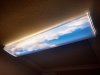
Hi everyone! A client of mine has a series of skylights (flat, not domed) that are about 2.5ft x 5ft give or take. There several dozen in total. They find the summer sun is beating in and causing their facility to overheat, making it uncomfortable for patrons and staff alike. So they initially asked me to block these out entirely with black vinyl. That is obviously a bad idea because of the high risk of heat absorption causing the windows to crack.
I am thinking a reflective / tint film is the way to go, and my preference is that (a) it can be applied to the exterior because rooftop access on foot is a heck of a lot easier than renting a scissor lift and getting in everyone's way from the inside, and also I think it'll do a better job of bouncing the sunlight off and away rather than absorbing it through the glass, and (b) it can be installed wet.
Unfortunately, all my tried, tested & true sign supply vendors do not seem to have any suitable materials. They all deal with automotive tints rather than commercial window tints.
I did a little research and came across 3M Prestige Exterior Sun Control Window Film, which sounded absolutely perfect, but then found out that I cannot simply purchase the material - I have to get it produced and installed by authorized distributors, which is a hard no for me. I don't want a competitor hanging around my clients.
Today I thought I'd found something in Gila, but their films are only rated for interior application.
So my question is - does anyone have any experience with this? Is there a material you can recommend or advice you can give?
I am thinking a reflective / tint film is the way to go, and my preference is that (a) it can be applied to the exterior because rooftop access on foot is a heck of a lot easier than renting a scissor lift and getting in everyone's way from the inside, and also I think it'll do a better job of bouncing the sunlight off and away rather than absorbing it through the glass, and (b) it can be installed wet.
Unfortunately, all my tried, tested & true sign supply vendors do not seem to have any suitable materials. They all deal with automotive tints rather than commercial window tints.
I did a little research and came across 3M Prestige Exterior Sun Control Window Film, which sounded absolutely perfect, but then found out that I cannot simply purchase the material - I have to get it produced and installed by authorized distributors, which is a hard no for me. I don't want a competitor hanging around my clients.
Today I thought I'd found something in Gila, but their films are only rated for interior application.
So my question is - does anyone have any experience with this? Is there a material you can recommend or advice you can give?