
-
I want to thank all the members that have upgraded your accounts. I truly appreciate your support of the site monetarily. Supporting the site keeps this site up and running as a lot of work daily goes on behind the scenes. Click to Support Signs101 ...
You are using an out of date browser. It may not display this or other websites correctly.
You should upgrade or use an alternative browser.
You should upgrade or use an alternative browser.
How to age / weather a new sign...
- Thread starter tulsagraphics
- Start date

tulsagraphics
New Member
Thanks!Wow - lookin' good!

tulsagraphics
New Member
Yeah, I sort of jumped the gun on the routing since the texture was my biggest concern. For this test run I'll have to paint those edges and carefully sand them back down.Given that explanation, it seems the best way to reproduce the worn out sign would be to use plywood. No guarantees on what the inner layer will look like, so it may or may not have the horizontal "boards" of the original. And given the lower quality of lumber nowadays, it will probably be crappy looking wood.
I think you could do this with MDO. Using your vector drawing, make a paper pattern and pounce it onto the primed MDO. Hand paint the design, probably in several coats with adequate drying time. Make sure to go outside the outer lines ("bleed"). Then do a very shallow routing of all the outside of the design, just taking away the resin laminate and adhesive, and exposing the underlying top layer of the plywood. If desired, also route the separation of the "boards" the original had.
If you want there to be wood grain showing through the paint, you'd have to use plywood without overlay. However to get to the next layer of plywood would be probably almost a 1/8" depth.
The MDO is already primed/painted white. Would you suggest going over the white elements with white paint too? I'm thinking yes, because we don't really know how "good" that pre-finished surface really is.
I just hope there are some high quality MDO options available when I buy new sheets. This scrap piece I'm working on is 10-11 years old, so the quality may have dropped since then.
tulsagraphics
New Member
Thanks! More photos coming soon!Looks awesome!!! Like you said, at this point, who cares about the money, what a FUN project!
My vote is for faded over Pantone.
tulsagraphics
New Member
Cool. Thanks!The prefinished white is usually okay. Since the goal is to replicate aged paint, it would probably be okay to just distress it and not put another coat of white over it. Unless they opt to make all the painted areas look like they were just freshly repainted.
tulsagraphics
New Member
They decided to go with the official branded colors since the older, faded paints were just too far off. (I'll need to age it a bit, of course)
What's a good paint for this type of project? Got a favorite? Price doesn't matter "that" much.
What's a good paint for this type of project? Got a favorite? Price doesn't matter "that" much.
Attachments

Last edited:

John_Smith
Enjoying retirement in Central Florida
What kind of work do you normally do? Do you do a lot of actual "painting"?
What kind of MDO are you using? I think a lot of us here are surprised that you are using a CNC to strip off the paper liner to achieve the weathered effect.
I know that you are fairly new to this, but, there are at least a dozen options where you could have built the whole sign in one workday, and still have it pass inspection of the client. (of course, painting would take a few more days). Sandblasting and HDU would also be at the top of my list.
As for paint - - - ask your local house painter what stands up against your local atmospheric conditions the best.
For this project, they may even give you small amounts if you drop their name around town.
Also, rotating the sign 180* yearly would help with equal weathering.
What kind of MDO are you using? I think a lot of us here are surprised that you are using a CNC to strip off the paper liner to achieve the weathered effect.
I know that you are fairly new to this, but, there are at least a dozen options where you could have built the whole sign in one workday, and still have it pass inspection of the client. (of course, painting would take a few more days). Sandblasting and HDU would also be at the top of my list.
As for paint - - - ask your local house painter what stands up against your local atmospheric conditions the best.
For this project, they may even give you small amounts if you drop their name around town.
Also, rotating the sign 180* yearly would help with equal weathering.
Last edited:
tulsagraphics
New Member
Just whatever I bought from GSG a decade ago. I'd be hard pressed to figure out who the manufacturer was. For new sheets I would simply try to source the best quality MDO available. (I don't mind if it has knots -- I actually prefer them -- but the higher quality stuff might be less likely to warp?)What kind of MDO are you using? I think a lot of us here are surprised that you are using a CNC to strip off the paper liner to achieve the weathered effect.
I know that you are fairly new to this, but, there are at least a dozen options where you could have built the whole sign in one workday, and still have it pass inspection of the client. (of course, painting would take a few more days). Sandblasting and HDU would also be at the top of my list.
I considered HDU (for CNC work, as I don't own / never used a sand blaster). It's reportedly great stuff to work with -- but even if I nail the texture on this pricey stuff ($315/sheet is the lowest cost in stock option right now) -- the added challenge of getting a realistic grayish-brown layered plywood effect could be pretty tough (in terms of color) since it doesn't have a natural grain. Wood is easy to stain and is very predictable. I'm not a paint / stain pro, but I feel a lot more comfortable staining wood... at least at this point in my journey. I have no doubt there are easier / better ways. This is my very first attempt at CNC routing (something other than ACM/acrylic), first time hand painting, first time aging something. I could easily farm this out to a 3rd party if I just wanted to do business as usual, but I'm here to learn (even if it's the hard way).
Last edited:
tulsagraphics
New Member
Oh, I missed your first question. For the past 26 years, I've always been the vinyl guy. Decals, wraps, banners, all the usual things.What kind of work do you normally do? Do you do a lot of actual "painting"?
And for the past 8 years (since acquiring the Rolls Roller) I started supplying sign faces for other shops (very strong focus on high quality prints / translucents / color matching). I would occasionally install signs for my own customers, but I often did trade outs with other local shops who had all the trucks / crews / gear. I'd make their faces, and they would do my installs. It was great.
But several years back, the 3 main shops in my area closed down (retired or passed). Now, the closest shops who can do (what I previously couldn't) are 60-70 miles away ($$$$). So in the past 6 months I purchased a lift, a CNC for making my own dimensional letters, started getting into lighting, painting, making trim cap faces, "some" metal fab work (frames), flex face installs, channel letter installs, etc. I'm basically diving head first into a whole other world of sign making without a lick of training. Not that those things are particularly difficult themselves, as most processes follow logic, but all at once? It's a lot to take on for a (100% self-taught) one-man shop. Of course, none of these thing are truly hand-crafted. I've got a good eye and a steady hand -- just no experience with hand painting. We'll see how that goes next week. Fingers crossed!
John_Smith
Enjoying retirement in Central Florida
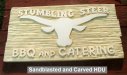
This is sandblasted and hand-carved HDU - When it first came on the market 35 years ago, I stopped using wood almost entirely and focused on texturing HDU to resemble wood with 100% success as opposed to wood projects.

tulsagraphics
New Member
Oh wow. that looks great! I'm guessing the logo / letters are sandblasted. Surely that wood grain texture takes a great deal of time to hand carve. What's the size on that? Looks to be about 24" x 12".This is sandblasted and hand-carved HDU - When it first came on the market 35 years ago, I stopped using wood almost entirely and focused on texturing HDU to resemble wood with 100% success as opposed to wood projects.
View attachment 181643
View attachment 181644
View attachment 181645
Last edited:
tulsagraphics
New Member
Follow up... I accidentally fell down the sandblasting rabbit hole. Oops. >.>
So, there are sandblasting screens out there for creating a wood grain effect (sounds like a really niche market btw). Never having sand blasted anything before -- I'm first thinking about how these wires are too far apart to create a finer "plywood-esque" pattern (highly doubtful "plywood-esque" will be Webster's word of the year, but you never know! lol)... but I guess you could use a frame like that, blast away, then move it over by an 1/8" or w/e and hit it again. Rinse n' repeat, then rotate the frame 90° and keep going. Maybe something like that? (or maybe it's a gun angle thing)
I'm not "as" concerned about machine time on the CNC. It's not running very often (yet), and I'd rather see it make dust instead of collect dust. When balancing out the labor + machine time vs. the high HDU panel costs, it might be worth the HDU investment. But how well does it stain -- in terms of dimensional texture? (e.g. darker in the grooves) Looking at your awesome work, is that a stain doing it's own thing? Or did you have to work it over somehow? And it would it be hard to make a finer texture than that?
So, there are sandblasting screens out there for creating a wood grain effect (sounds like a really niche market btw). Never having sand blasted anything before -- I'm first thinking about how these wires are too far apart to create a finer "plywood-esque" pattern (highly doubtful "plywood-esque" will be Webster's word of the year, but you never know! lol)... but I guess you could use a frame like that, blast away, then move it over by an 1/8" or w/e and hit it again. Rinse n' repeat, then rotate the frame 90° and keep going. Maybe something like that? (or maybe it's a gun angle thing)
I'm not "as" concerned about machine time on the CNC. It's not running very often (yet), and I'd rather see it make dust instead of collect dust. When balancing out the labor + machine time vs. the high HDU panel costs, it might be worth the HDU investment. But how well does it stain -- in terms of dimensional texture? (e.g. darker in the grooves) Looking at your awesome work, is that a stain doing it's own thing? Or did you have to work it over somehow? And it would it be hard to make a finer texture than that?
Last edited:
John_Smith
Enjoying retirement in Central Florida
Sandblasting signs is an art in itself. It could take a novice hours, weeks, months, or never, to become good at it.
Yes, there are wireframes to make the grain effect. I made my own where I could blast 3x8 foot sections without moving it.
I also made an air-tight room in my shop just for sandblasting HDU with aluminum oxide, as the oxide can be reclaimed and recycled hundreds of times, whereas silica sand is a one-time deal.
There are some members here who attended a Letterheads Meet at my shop in 2002 who got to use the blasting booth.
Pace yourself carefully when adding new "methods" to your portfolio.

Yes, there are wireframes to make the grain effect. I made my own where I could blast 3x8 foot sections without moving it.
I also made an air-tight room in my shop just for sandblasting HDU with aluminum oxide, as the oxide can be reclaimed and recycled hundreds of times, whereas silica sand is a one-time deal.
There are some members here who attended a Letterheads Meet at my shop in 2002 who got to use the blasting booth.
Pace yourself carefully when adding new "methods" to your portfolio.
Last edited:
John_Smith
Enjoying retirement in Central Florida
One day, after a long session with walk-in customers, I decided enough was enough. I went outside, tore the sign off the building, cut it up with my circular saw, and made a fire right there, and it went up in smoke. (and yes, it was an A.R.I.).
I built a website and only made signs through internet orders that I could ship with USPS, UPS, or common carrier. No more walk-in headaches.
And, I never looked back. That was around 2004.
I built a website and only made signs through internet orders that I could ship with USPS, UPS, or common carrier. No more walk-in headaches.
And, I never looked back. That was around 2004.
John_Smith
Enjoying retirement in Central Florida



tulsagraphics
New Member
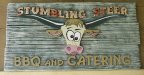
Wow, very cool!Small HDU signs like this were my bread-n-butter. (Note: No CNC was used).
View attachment 181651
View attachment 181653
View attachment 181652
tulsagraphics
New Member
Something that crossed my mind was -- handing over some pre-stenciled sheet of HDU and a grain screen to a local sandblaster could help make my sign (Obviously that's a pipe dream, now that I'm researching it). After watching a handful of YT sandblasting / technique videos -- sandblasting signs IS a whole thing in/of itself. And a fair bit of work to boot (especially in terms of using real wood / joined planks). Videos make it look easy when they're performed by the seasoned pros. Very cool stuff.Sandblasting signs is an art in itself. It could take a novice hours, weeks, months, or never, to become good at it.
Yes, there are wireframes to make the grain effect. I made my own where I could blast 3x8 foot sections without moving it.
I also made an air-tight room in my shop just for sandblasting HDU with aluminum oxide, as the oxide can be reclaimed and recycled hundreds of times, whereas silica sand is a one-time deal.
There are some members here who attended a Letterheads Meet at my shop in 2002 who got to use the blasting booth.
Pace yourself carefully when adding new "methods" to your portfolio.
View attachment 181650
John_Smith
Enjoying retirement in Central Florida
You are very correct - sandblasting is an art form in itself. Just like hand carving or hand painting. A certain amount of "artistic skill" is required.
If a person is only experienced in entering designs into a computer and spitting out vinyl, they will be going down a road full of frustration and disappointment, as well as a certain amount of financial strain when things don't go well.
When I hear about someone wanting to try sandblasting, I encourage them to visit a sign shop that specializes in sandblasting just for a short tour. (it won't hurt to ask).
The sign people that I hang out with have a motto: "Learn one, Do one, and Teach one" in order to keep the craft alive. Sadly, this age group with those core values is dwindling at a rapid pace.
Stay with your CNC for a while and get to know it before changing horses in mid-stream.
Right now, we are excited to follow you in the Eskimo Joe's journey and see your finished project.

If a person is only experienced in entering designs into a computer and spitting out vinyl, they will be going down a road full of frustration and disappointment, as well as a certain amount of financial strain when things don't go well.
When I hear about someone wanting to try sandblasting, I encourage them to visit a sign shop that specializes in sandblasting just for a short tour. (it won't hurt to ask).
The sign people that I hang out with have a motto: "Learn one, Do one, and Teach one" in order to keep the craft alive. Sadly, this age group with those core values is dwindling at a rapid pace.
Stay with your CNC for a while and get to know it before changing horses in mid-stream.
Right now, we are excited to follow you in the Eskimo Joe's journey and see your finished project.