• I want to thank all the members that have upgraded your accounts. I truly appreciate your support of the site monetarily. Supporting the site keeps this site up and running as a lot of work daily goes on behind the scenes. Click to Support Signs101 ...

Recommended Router Bits for 45 Degree Beveled Edge

Think713

New Member
Hey everyone,
So far I have not found a particular bit that does this (i have found some for acm bevels for "bending). Our Collet is sized for a 6mm shank. I'm looking for a a bit that I can route 45 degree edges like you would cut with a miter saw.
Now any of you that are familiar with woodworking can probably tell me whether or not thats a good idea, and it might just be better to go ahead and cut the pieces I want on a miter saw. But I do not have one. I guess the biggest issue would be hold down for said material and making sure it doesnt move on the final pass.

That being said if its possible and there is a good bit out there, can you guys point me in the right direction?
 

JBurton

Signtologist
You probably also want to finish with a straight bit, leaving a 1/16" or thicker flat edge. A true 45 on an edge is just waiting to get damaged.
 

Think713

New Member
You probably also want to finish with a straight bit, leaving a 1/16" or thicker flat edge. A true 45 on an edge is just waiting to get damaged.
So the goal is to route all the sides of a box to put them together. I will be likely wood glueing all those sides and using brackets on the inside. So I need the edges to be sharp to meet clean all the way around. I still dont know if itll just be better to cut the wood on a miter saw, but only one way to find out.
 

JBurton

Signtologist
route all the sides of a box to put them together.
You'll want to make sure you're working on a very flat section of your table... or get a table saw. I don't think a miter saw would make this easier than a router, but a table saw with a good true stop should.
As far as hold down, I figured a colex would have a vacuum hold down? Stepping the bit through, you'll want to slow down as you max out the depth, every pass is taking more material due to more cut area being exposed. Also the width of your V bit will need to be twice the thickness of your material, otherwise you'll have to offset a series of cuts to get the 45 from top to bottom.
 

Think713

New Member
You'll want to make sure you're working on a very flat section of your table... or get a table saw. I don't think a miter saw would make this easier than a router, but a table saw with a good true stop should.
As far as hold down, I figured a colex would have a vacuum hold down? Stepping the bit through, you'll want to slow down as you max out the depth, every pass is taking more material due to more cut area being exposed. Also the width of your V bit will need to be twice the thickness of your material, otherwise you'll have to offset a series of cuts to get the 45 from top to bottom.
The colex does have a vacuum hold down. But in my experience, pieces that are light, thin or detailed tend to shift at the end of a cut. So I'm a little curious about the best way to address that if it becomes an issue.
If I'm going down in steps, how many would you say would be the best? I'm most likely going to be routing 1x4s so those are what? .75 x 3.5 normally? So Im thinking .25" steps? so 3 maybe?
 

JBurton

Signtologist
I'm most likely going to be routing 1x4s
Oh thats going to be rough. and depending on the precision you're aiming for, it's damn near impossible. You'd need to plane the boards until they are all the same thickness, but 1x4's are going to be warped... I'd try talking someone into using MDO or MDF depending on the actual application, MDF will have the more consistent thickness, but it will absorb water and get ruined pretty quickly if this is going outside.
At .75" thickness, you'd need a 1.5" diameter bit to cut through straight down (which you don't want such a large bit on a small shank), otherwise you'll need to offset each pass to get all the way through while maintaining the 45 degree bevel, which means you'll have to rough out some of the outer edge before making pass 2. What software are you using to make files for the router?
 

Think713

New Member
Oh thats going to be rough. and depending on the precision you're aiming for, it's damn near impossible. You'd need to plane the boards until they are all the same thickness, but 1x4's are going to be warped... I'd try talking someone into using MDO or MDF depending on the actual application, MDF will have the more consistent thickness, but it will absorb water and get ruined pretty quickly if this is going outside.
At .75" thickness, you'd need a 1.5" diameter bit to cut through straight down (which you don't want such a large bit on a small shank), otherwise you'll need to offset each pass to get all the way through while maintaining the 45 degree bevel, which means you'll have to rough out some of the outer edge before making pass 2. What software are you using to make files for the router?
Itll be fine. I'm going to use boards that are bigger than that so I can cut them down. Nothing is going outside. I'm using illustrator. I just need to route rectangles. Its not gonna be some extravagent thing. I have already built a box not using bevel edges and sanded the joined pieces after they were assembled. It worked perfect, and stained it after. The ONLY difference is routing the shapes to get meeting edges at 45 degrees. If i can mill designs into boards I dont see what would be difficult about just running the bit like any other job? 2 passes would be easy to setup. Its just another cut layer. BTW this is for personal projects. Its more of a test to see what I CAN or CANT do with the router we have. IF I can make this work, then I don't have to outsource any woodworking. OR I have to get a miter or table saw. Which I don't really have in my budget to be buying one that does what I need it to.
 

John_Smith

Enjoying retirement in Central Florida
Thanks - do you have a router table? Table saw? CNC? Or, are you doing it free-hand. What is your routering and woodworking experience?
Drop by one of my woodworking forums for some very helpful information in your project. www.routerforums.com and give specifics of how big of a box, what will it be used for, and your realistic expectations for the finished project.
This forum is tailored towards sign makers.
 
Last edited:

bob

It's better to have two hands than one glove.
You're trying to use the wrong tool, especially if the angled cut is a bevel on the entire edge. What you need here is a table saw. Or, a distant second, a router mounted in a table using a bit with pilot bearing or a good fence.
 
  • Agree
Reactions: 1 user

Think713

New Member
You're trying to use the wrong tool, especially if the angled cut is a bevel on the entire edge. What you need here is a table saw. Or, a distant second, a router mounted in a table using a bit with pilot bearing or a good fence.
Thats what I asked in the first place in whether or not it made sense to even do this. It does make sense to just use a miter or table saw. But i dont see why a 45 degree router bit cant do it.
 

Think713

New Member
Thanks - do you have a router table? Table saw? CNC? Or, are you doing it free-hand. What is your routering and woodworking experience?
Drop by one of my woodworking forums for some very helpful information in your project. www.routerforums.com and give specifics of how big of a box, what will it be used for, and your realistic expectations for the finished project.
This forum is tailored towards sign makers.
This thread is posted in the COLEX section of this forum, so yes i am using CNC. I don't have exact measurements of the box yet because Idk what they're be until I know whether or not this can be done. It doesn't make sense that these bits exist to ONLY engrave.
I understand that this forum is for sign makers, but it encompasses all things that are adjacent to this world. Simply changing the medium to wood vs a piece of ACM in my mind makes marginal difference. The concept of what I am doing remains the same.
 

John_Smith

Enjoying retirement in Central Florida
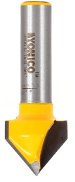
Okay, I understand now. . . . absolutely, the standard V-Carve bits in your CNC will do what you want. I am dedicated to the YONICO brand, but you can get whatever you want in any size you think would be appropriate for your project. They are not expensive, so you won't have too much invested to make your prototypes. Come back and let us see your projects. Once you get over 1" wide and 1/2" deep, you'll have to figure out how to make multiple passes. If you are using 3/4" thick wood, and a larger bit is needed, they can get expensive real quick.
Carve Bit.jpg
 
Last edited:
  • Agree
Reactions: 1 user

JBurton

Signtologist
Once you get over 1" wide and 1/2" deep, you'll have to figure out how to make multiple passes. If you are using 3/4" thick wood, and a larger bit is needed, they can get expensive real quick.
That's what I said!

The problem with using like a 1/2" wide V bit to cut all the way through is the shoulder you will leave if your substrate is thicker than 1/4". Here is a picture as an example.
1780075807404.png
In order to get the 45 to extend all the way to the 'back' side of the panel, you'll have to run it 3 times, on 3 different toolpaths. Like this
1780075985331.png
And each one of those will need to be stepped in, or roughed out with a square end mill, if you have tool change capabilities, otherwise I'd step it through at maybe 1/8" per pass. The first pass will seem very easy, but the second pass is going to be 3-4 times the load on the bit.
If these aren't going outside, I'd really recommend a partial sheet of MDF from lowes or hd. It'll give you way more hold down area than a 1x4, be flat, and MDF is a much easier cut, though it is messier. Plus it will be flat and have a consistent thickness, which should save time on finishing the parts to get a perfect fit.

All that said, I agree with John on the yonico bits, I've gotten them a handful of times and they've worked just as well as high dollar vortex bits and the like, but I'm not a wood worker so I'm probably not pushing the tools to the limit.
 
  • Agree
Reactions: 1 user

John_Smith

Enjoying retirement in Central Florida
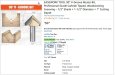
THIS BIT should chamfer 3/4" thick material in one pass at a slow speed. Available in 1-1/2" and 2" diameter.
Screenshot 2026-05-29 135742.jpg
 
  • Agree
Reactions: 1 users
Top